 Beaujolais Tours
Home › Guides › Beaujolais Wine Region: Map, Appellations and Where the Tours Go
Beaujolais Wine Region: Map, Appellations and Where the Tours Go
The Beaujolais wine region is a 55 km strip of vineyards north of Lyon, and a TER train reaches Villefranche-sur-Saône in about 25 minutes. This page covers where it lies, its 12 appellations, how to get around and which tours go where.
Quick answer Size, appellations and how to reach it from Lyon
The Beaujolais wine region runs 55 km north to south between Lyon and Mâcon, with 12,520 hectares of vines and 12 appellations. Villefranche-sur-Saône, its economic capital, is 35 km from Lyon and about 40 minutes by car. Estates need a car or a driver, so most visitors go on a day tour from Lyon.
Key takeaways
- Compare every day trip from Lyon on the beaujolais wine tours homepage.
- Want south to north in one day? Beaujolais Full-Day Winery Tour with Tastings from Lyon goes via Oingt and lists tasting fees as included.
- Want most of the 10 crus with a private driver? Beaujolais Full-Day Private Tour by Vintage Land Rover does it in 8 hours.
- Driving yourself? The French limit is 0.5 g/L, so a driver's day on Beaujolais Tours keeps the tastings worry-free.
Which Tours Cover the Beaujolais Wine Region?
Both tours leave from the Lyon side and cover more than one part of the region, one in a small group and one private.
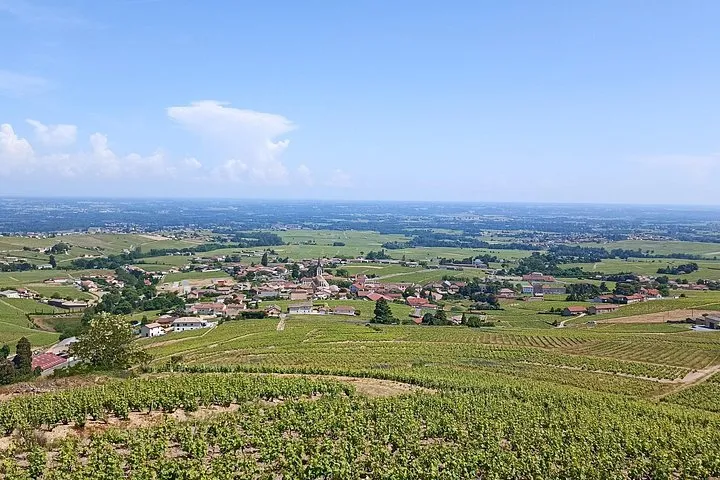 from $177.86
Beaujolais Full-Day Winery Tour with Tastings from Lyon
A founder-led day for 8 guests from south to north, about 10 wines, lunch booked but paid separately.
Check Availability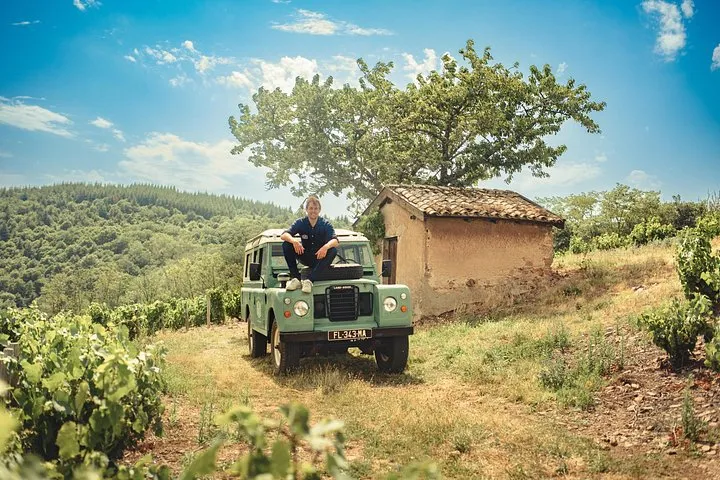 from $548.13
Most reviewed
Beaujolais Full-Day Private Tour by Vintage Land Rover
The most reviewed private Defender day, planned with you 72 hours ahead and covering most of the 10 crus.
Check AvailabilityWhere Is the Beaujolais Wine Region and How Big Is It?
It lies between Lyon and Mâcon, runs 55 km north to south and 15 to 20 km east to west, and holds 12,520 hectares of vines.
The vineyard is compact. A visitor can cross it from one end to the other in a day, which is why it works so well from Lyon. The ten crus are on cru Beaujolais and the golden-stone village on Oingt.
Borders and size
Burgundy lies to the north, the Saône river to the east, Lyon to the south and the Monts du Beaujolais to the west. The vines grow at 180 to 550 metres. The vineyard edge is less than a 30-minute drive from Lyon, while Villefranche-sur-Saône in the middle is about 40 minutes away.
Inter Beaujolais counts 12,520 hectares of vines across 96 communes. Gamay covers 96% of them and chardonnay about 4%. More than half of the gamay noir à jus blanc planted in France grows here.
| Fact | Figure |
|---|---|
| Length north to south | 55 km |
| Width east to west | 15 to 20 km |
| Altitude of the vines | 180 to 550 metres |
| Vines | 12,520 hectares |
| Communes | 96 |
| Appellations | 12 |
| Grapes | Gamay 96%, chardonnay about 4% |
A UNESCO Geopark under the vines
The Beaujolais has been a UNESCO Global Geopark since 2018. It brings together 121 communes on 1,550 square kilometres, and its geological history goes back about 500 million years.
Sources: Inter Beaujolais, French Ministry of Agriculture, Géoparc Beaujolais.
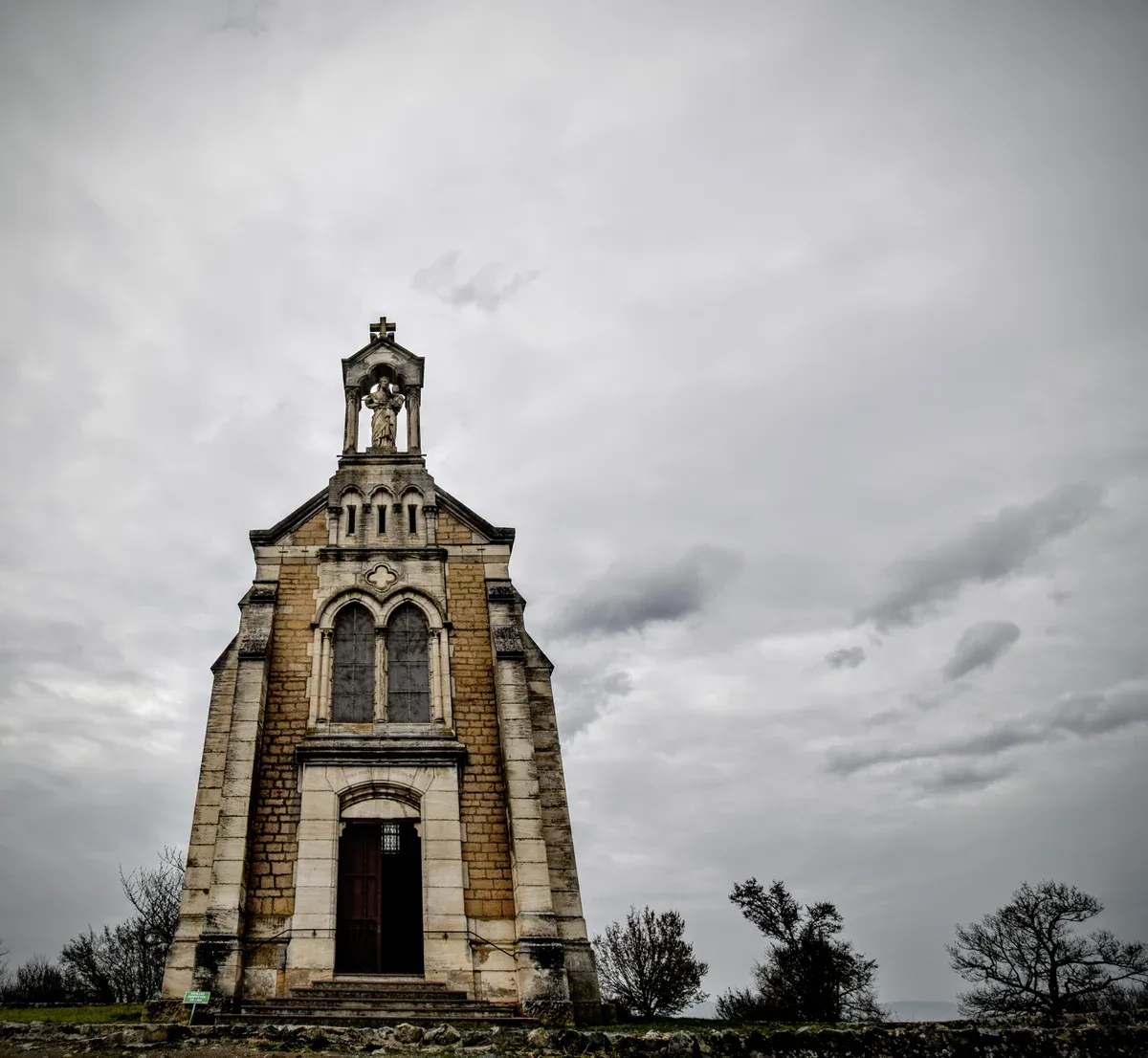
The Chapelle Notre-Dame-aux-Raisins on Mont Brouilly. Photo: Weekend Wayfarers, CC BY 2.0, via Wikimedia Commons
What wine region is Beaujolais in?
Beaujolais is administratively part of Burgundy, but its climate is closer to the Rhône and its grape is Gamay.
The answer depends on whether you ask a map, a wine label or a train timetable.
Burgundy on paper, Rhône in practice
Beaujolais borders Burgundy to its north. Its climate is closer to the Rhône. A ducal decree of 1395 banned Gamay in Burgundy.
The appellation covers 85 communes in the Rhône department and 11 in Saône-et-Loire. For a trip it matters little. You leave from Lyon, the Rhône side, and the northernmost cru, Saint-Amour, lies in Saône-et-Loire.
Source: French Ministry of Agriculture.
Beaujolais Wine Region Map
The vineyard runs about 55 km between Lyon and Mâcon: the ten crus in the north, the Pierres Dorées in the south and the towns between them. Tap a pin for the place.
Pins from OpenStreetMap.
What is the main town in Beaujolais?
Beaujeu is the historic capital and Villefranche-sur-Saône is the economic capital and the town with the train station.
Two towns share the title, and a visitor needs both.
Villefranche-sur-Saône
Villefranche is about 30 km from Lyon and a Ville et Pays d'Art et d'Histoire. Its Circuit des Trésors Cachés has 24 stops and the Musée des Conscrits covers the January Conscrits festivities. The tourist office is at 96 rue de la Sous-Préfecture.
It opens Monday to Saturday 9:30 to 12:30 and 14:00 to 18:00 from May to September, and closes at 17:00 from October to April. It is shut on 1 November, 25 December and 1 January.
Beaujeu
Beaujeu is the historic capital and gave its name to the region and the appellation. Its Romanesque Église Saint-Nicolas was built by the sires de Beaujeu. The tourist office at 8 place de l'Hôtel de Ville opens Wednesday to Sunday 9:30 to 12:30 and 14:00 to 17:00 from 1 October to 22 November.
Sources: Destination Beaujolais, Destination Beaujolais.
What Are the 12 Beaujolais Appellations?
Two broad southern appellations, Beaujolais and Beaujolais Villages, plus 10 northern crus that make only red.
The 12 appellations follow the soil from south to north, and each one is a different stop for a visitor.
The appellations and their official figures
Beaujolais and Beaujolais Villages make red, rosé and white. The 10 crus are 100% red. The table lists each appellation with the hectares Inter Beaujolais gives.
| Appellation | Where | Hectares | Good to know |
|---|---|---|---|
| Beaujolais | South, 72 communes | 3,930 | Red, rosé and white, the white from chardonnay |
| Beaujolais Villages | Northern half, 38 communes | 3,390 | 30 communes in the Rhône and 8 in Saône-et-Loire |
| Saint-Amour | Saint-Amour-Bellevue, the northernmost cru | 310 | Saône-et-Loire |
| Juliénas | Four communes | 575 | Mostly Rhône, a small part in Saône-et-Loire |
| Chénas | Chénas and La Chapelle-de-Guinchay | 250 | Shares its land with Moulin-à-Vent |
| Moulin-à-Vent | Romanèche-Thorins and Chénas | 640 | Windmill from the 15th century |
| Fleurie | The commune of Fleurie | 840 | Pink granite, about 90% of the terroir |
| Chiroubles | One commune, vines at 270 to 600 metres | 315 | Pink granite, harvest about a week later |
| Morgon | Villié-Morgon | 1,090 | Granite 52%, blue stone 37%, piedmont deposits 11% |
| Régnié | Régnié-Durette and Lantignié | 550 | Recognised in 1988 as the tenth cru |
| Côte de Brouilly | Slopes of Mont Brouilly, four communes | 310 | Chapel at the summit since 1854 |
| Brouilly | Six communes around Mont Brouilly | Not stated | AOC since 1938, over 8 million bottles a year |
Which appellations to visit
The south holds Beaujolais and Villages, the north holds the crus. Each tour below states its own area, so check it before booking.
Sources: Inter Beaujolais, Inter Beaujolais, Inter Beaujolais, Inter Beaujolais, French Ministry of Agriculture.
How Do the North and South of Beaujolais Differ?
The north has granite and schist and the crus, the south has clay and limestone and the golden Pierres Dorées villages.
The split decides what your tour looks like, because the two halves offer different scenery as well as different wines.
The golden stone south
The Pierres Dorées area lies at the gates of Lyon in the south. Limestone takes a golden colour there when iron oxides tint it, and about forty villages are built from it, known as the little Tuscany. Most Beaujolais wine comes from south of Villefranche-sur-Saône.
Oingt is its Plus Beaux Villages de France.
The granite north
North of Villefranche the soils turn to granite and schist, and the vineyards climb into hills. Morgon, Fleurie and Chiroubles sit here, with Mont Brouilly rising out of the vines. Fleurie roads have hairpin bends, so a small car or a driver helps.
Which tour goes where
Each listing states its own area. Prices are per person as listed.
| Area | Tour | Length | Price |
|---|---|---|---|
| South, Pierres Dorées | Pierres Dorées Half-Day Wine Tour | 4.25 hours | $110.74 |
| South, Oingt | Oingt and Beaujolais Wine Discovery | 4.5 hours | $121.93 |
| North, crus | Beaujolais Crus and Châteaux Afternoon Tour | 4.5 hours | $121.93 |
| South to north | Beaujolais Full-Day Winery Tour with Tastings from Lyon | 8-9 hours | $177.86 |
| Most of the 10 crus, private | Beaujolais Full-Day Private Tour by Vintage Land Rover | 8 hours | $548.13 |
Sources: INAO, Destination Beaujolais, Lyon Tourist Office.
How Do You Get to the Beaujolais Wine Region From Lyon?
Take a TER train to Villefranche-sur-Saône in about 25 minutes, or drive 35 km in about 40 minutes on the A6.
The train gets you to the towns. The estates are another matter.
By train, bus and car
TER trains leave Lyon Part-Dieu or Perrache for Villefranche-sur-Saône in about 25 minutes, and also serve Belleville-en-Beaujolais. Bus lines 115 and 118 run from Vaise station. Lyon Tourist Office suggests a day trip leaving Lyon at 9:00 and back by 18:00.
By road Villefranche is 35 km from Lyon on the A6. Lyon Saint-Exupéry airport is about 45 km and 45 minutes away, and the Rhône Express tram links it to Part-Dieu. From Paris the TGV takes about 1 hour 40 to Mâcon-Loché-TGV or 2 hours to Lyon.
Driving is necessary for most estates and hire drivers are few, so a tour that leaves from Place Bellecour is the simpler choice. Beaujolais Full-Day Winery Tour with Tastings from Lyon meets at the foot of the Saint-Exupéry statue next to Café Bellecour, 10 minutes before departure.
Distances to Villefranche
| From | Distance | Time |
|---|---|---|
| Lyon | 35 km | About 40 minutes by car |
| Mâcon | 40 km | 35 minutes |
| Saint-Étienne | 95 km | Not stated |
| Geneva | 165 km | Not stated |
| Paris | 440 km | 4 hours 30 |
Drink-driving limits
In France you are over the limit at 0.5 g/L of blood, or 0.25 mg/L of breath. From 0.5 to under 0.8 g/L the fine is up to 750 euros and 6 points off the licence. At 0.8 g/L or more it is a criminal offence with a fine of up to 9,000 euros and up to 3 years in prison.
Probationary licence holders may not drive at 0.2 g/L or more. A tasting day is a day for a driver.
Sources: Destination Beaujolais, Lyon Tourist Office, Service-Public.fr.
What Is There to See in the Beaujolais Wine Region?
Oingt, Mont Brouilly and La Madone above Fleurie are the sights most visits are built around.
Each of these stops pairs a view with a vineyard.
Oingt
Oingt is the only village in the Rhône with the Plus Beaux Villages de France label, about 30 km from Lyon. The Tour d'Oingt was built before 1183, stands 18 metres tall and has 3 floors with a museum and a rooftop terrace with a 360 degree panorama. Entry is 2 euros and free for under 12s.
Visits are booked online or by phone on 04 72 52 97 33. On clear days the terrace shows the Jura, the Alps and Mont Blanc.
Mont Brouilly and La Madone
Mont Brouilly culminates at 484 metres. The Chapelle Notre-Dame-des-Raisins was built at its top in 1854, and the summit has a 360 degree panorama over blue volcanic rock under the vines. La Madone, the hill above the Fleurie vineyards, reaches 425 metres, and some Fleurie slopes have a 50% gradient.
Bagnols and Clochemerle
The Château de Bagnols was built between 1217 and 1221 and is now a hotel-restaurant. Vaux-en-Beaujolais, about 50 km from Lyon, inspired Gabriel Chevallier's novel Clochemerle, translated into 26 languages. Its walk passes the Pissotière, a fresco of the novel's characters and the Cave de Clochemerle.
Sources: Destination Beaujolais, Destination Beaujolais, Inter Beaujolais, Destination Beaujolais.
When Is the Best Time to Visit the Beaujolais Wine Region?
September has the fewest wet days, 9.5, with 21.4°C highs and 9.6 hours of sun a day.
Summer is warmest, and from October the rain rises to 107 mm and the sun falls to 7.4 hours a day.
Weather around the crus by month
The figures are averages for the vineyards around Villié-Morgon, 1995 to 2024. September has the fewest wet days of the year, 9.5, against 10.8 in July. By November the daily high is 10.4°C with about 105 mm of rain over 12.9 wet days.
Mid-November brings the Beaujolais Nouveau release, which falls on the third Thursday of the month.
| Month | High | Low | Rain | Sun hours a day |
|---|---|---|---|---|
| April | 15.7°C | 6.0°C | 86 mm | 10.0 |
| June | 23.8°C | 13.9°C | 91 mm | 12.3 |
| July | 25.8°C | 15.9°C | 93 mm | 12.5 |
| September | 21.4°C | 12.4°C | 87 mm | 9.6 |
| October | 16.9°C | 9.0°C | 107 mm | 7.4 |
| November | 10.4°C | 4.1°C | 105 mm | 5.5 |
Sources: Copernicus ERA5, Inter Beaujolais.
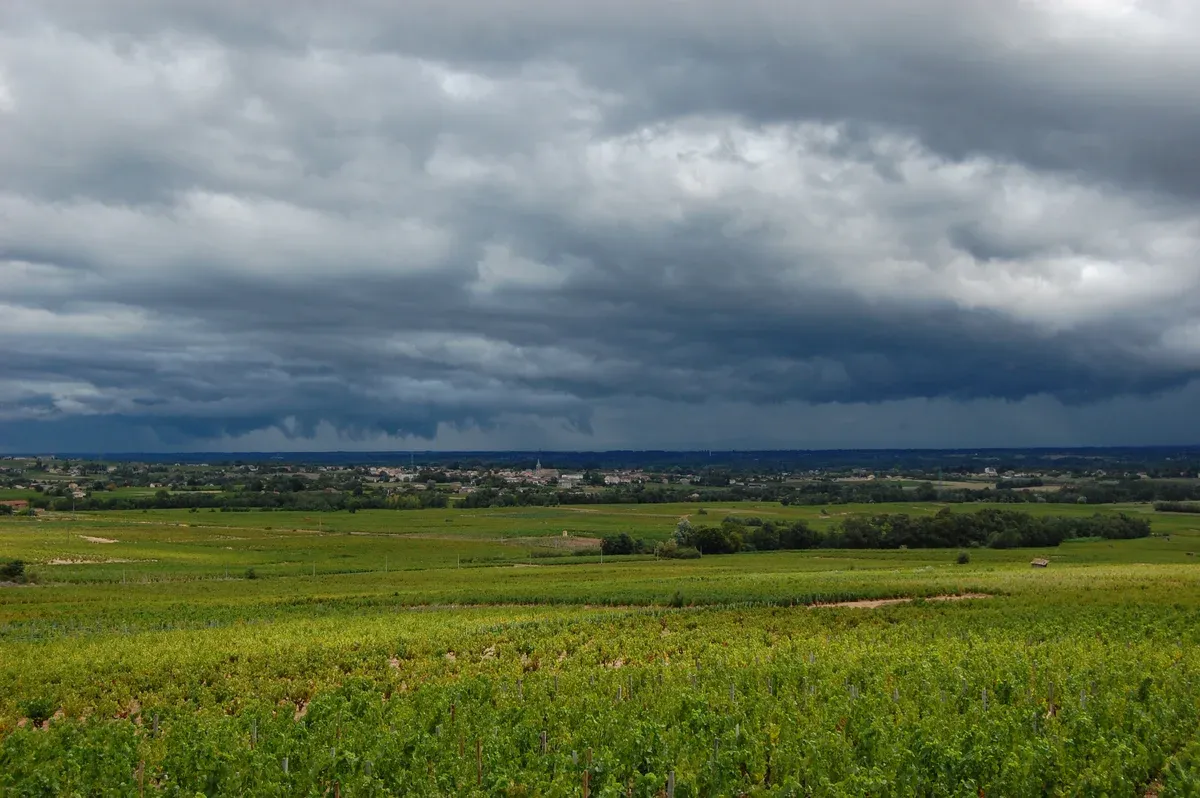
The Beaujolais vineyard landscape between Burgundy and the Rhône valley. Photo: karaian, CC BY 2.0, via Wikimedia Commons
Beaujolais Wine Region FAQ
Is Beaujolais a Pinot Noir?
No. Red Beaujolais is made from gamay noir à jus blanc, which covers 96% of the vineyard, though the grape is a cross of pinot noir and gouais. White Beaujolais is chardonnay. See which tours taste both on the beaujolais wine tours homepage.
Is Beaujolais cheap wine?
No bottle price is stated here, so there is no figure to quote. The region has 12 appellations from the broad Beaujolais label to 10 crus, so ask each estate for its list. Beaujolais Full-Day Winery Tour with Tastings from Lyon lists tasting fees as included.
What is the difference between Beaujolais and the crus?
Beaujolais and Beaujolais Villages grow in the south and the northern half, and make red, rosé and white. The 10 crus in the north make only red. Compare a half-day with a crus day on Beaujolais Tours.
Can you visit the Beaujolais wine region without a car?
Yes, by train to Villefranche-sur-Saône in about 25 minutes, but estates need a car or a driver. Beaujolais Full-Day Private Tour by Vintage Land Rover offers courtesy train tickets from Lyon to Belleville in 35 minutes.
How long does a Beaujolais wine tour from Lyon take?
The tours here run from 4 hours to 8-9 hours. Beaujolais Full-Day Winery Tour with Tastings from Lyon takes 8-9 hours and the Pierres Dorées half-day takes 4.25 hours.
Is the Beaujolais wine region part of the Rhône?
The appellation covers 85 communes in the Rhône department and 11 in Saône-et-Loire, so most of it is Rhône. The climate is also closer to the Rhône. Browse the region's tours at beaujolais wine tours.
More Guides
- Beaujolais Nouveau 2026 and 2027: Release Day and Where to Taste the New Wine
Beaujolais Nouveau in 2027: released on the third Thursday of November, with the Sarmentelles in Beaujeu. Check dates.
- Which Wine Tour from Lyon Should You Book: Beaujolais or Burgundy?
Wine tours from Lyon in 2027: Beaujolais half days from $110.74, full days and Mâconnais days from $162.20. Compare tours.
- What Are the 10 Cru Beaujolais Wine Villages, from North to South?
Cru Beaujolais in 2027: the 10 northern crus from Saint-Amour to Côte de Brouilly, plus tours from $121.93. Compare tours.